Tuesday, 8 September 2009

An Epic Search for Truth, with a Connection in Frankfurt


Normally I’d wait until I finish reading a book before I write my review. But LogiComix is – er, unusual, and not just because it’s a graphic novel about a dead logician. Three chapters into it, I’m captivated and enchanted by the playful, clever, innovative use of self-reference. For example, the prologue opens with co-author Apostolos Doxiadis reading a draft of his story. As we intrude upon his thoughts, he invites us to meet Berkeley computer scientist Christos Papadimitriou, whom Apostolos must recruit to help him with the book. When Apostolos tells Christos the story he’d like to craft, we, the readers, get to hear it too!

Along the way, Christos asks questions, points out problems, and makes suggestions to Apostolos as well as to his illustrators Alecos Papadatos and Annie di Donna. As the story unfolds, the creative team debate how to best move it forward. By the end Christos and we together come to understand that LogiComix is deliberately not LOGIC FOR DUMMIES, but rather a true story about passion, family, war, love, tragedy and hope.

So if the LogiComix creative team can be characters writing their story as it goes, then I can do the same in this review. If that violates some rule, I wouldn’t know because I am of course not a professional book reviewer. Here are my only qualifications for writing this review:

(i) I have a fancy degree in theoretical computer science centered mainly on the works of those logicians portrayed in this story.

(ii) As a practiced blogger, I can emulate authority on any subject.

(iii) My dear friend Vivian Leal of Kepler’s Bookstore asked me to review this book.

(iv) As I type, I am on a Lufthansa flight from St. Petersburg heading home to San Francisco, so I have some time.


When Vivian asked me to review LogiComix, I readily agreed. Not only do I love both Vivian and Kepler’s, but I can also say that I love Christos Papadimitriou. I’ve never met him, but he did also happen to co-author my favorite college textbook Elements of the Theory of Computation, a beautifully elegant introduction to Turing machines and recursion that even I could understand. His co-author back then was Harry Lewis, my CS121 professor and also my undergraduate advisor. (Still, like Papadimitriou, Lewis never knew who I was, though once he passed me by in Harvard Yard and raised his eyebrows at me in an acknowledging way that made me feel a real connection.) Coincidentally, I would have never met Vivian had I not befriended her husband Daniel 23 years ago back in CS121 – another debt I owe Christos Papadimitriou.


So far, the graphic novel format of LogiComix (now popularized by the Wimpy Kid and Maus series, as well as The Invention of Hugo Cabret) is working well for me. The throwback to comic books promises to make even Boolean Algebra an accessible topic to all, just as Scott McCloud recently did with a comic book about Google’s new Chrome browser architecture. But more importantly, Apostolos draws us into the story with visuals that not only support the narrative but also relay sub-plots and emotional texture. Often we see a human side to the characters that they otherwise don’t acknowledge, such as a jealous look from a wife, or a 12-year-old boy subtly covering his lap while his beautiful French nanny reads him a love sonnet. (I’m reminded of the beautiful French nanny who charmed me as well – so much so that I married her. Hmm, can’t this plane fly any faster?)

The excited 12-year-old is our hero – the great mathematician Bertrand Russell who devoted not only his career but his life to the pursuit of a provably logical foundation for mathematics, as Euclid had purportedly done for geometry (at least before Lobachewski and Riemann each had his way with Euclid’s assumptions). Embedding yet another layer of recursion into LogiComix, Russell tells his own story in the form of a lecture delivered at an American university on Sept 4, 1939, the day the UK joined World War II. The lecture, titled “The Role of Logic in Human Affairs” promises an answer to the question hurled at him by isolationists as to whether Russell, as a World War I conscientious objector, supports the war this time around.

Russell’s own account of his childhood is a contrasting story of privilege and borderline abuse. Orphaned as an infant, “Bertie” lived with his grandfather – a former British prime minister – and a domineering grandmother who imprisoned Bertie in rules and superstitions. Eventually Bertie discovered the family secret that madness had taken his father’s life and disabled his uncle. So when he learned geometry – constructed proof by proof upon common sense and reason – Bertrand embraced logic and science as tools to not only understand the world, but to preserve his own sanity.

Bertrand Russell’s Epic Search for Truth

Russell studies mathematics at Cambridge University, and proceeds to seek out the great minds of his time, to find some articulation and validation of the basic tenets underlying mathematics. Russell overcomes his shyness to engage the greatest professors of his time with his questions (a thrill I remember well from studying the Sacks Theorem of recursion theory from Professor Gerald Sacks himself).

Russell’s travels take him to Germany just 10 minutes before my Lufthansa pilot announces our imminent arrival in Frankfurt, where I’ll make my connection to San Francisco. Russell’s account of those days in Germany evokes that nation’s unique capacity for both logic and madness. There he meets his future best friend, housemate and collaborator Alfred Whitehead, who had created the first formal system for algebra. He meets Gottlob Frege, who had founded modern logic studies by introducing the concept of Boolean variables, though eventually Frege becomes paranoid, and as early as 1925 starts ranting about a Final Solution for the” Jewish problem.” Finally Russell meets Georg Cantor, inventor of Set Theory, who was already then living in a mental asylum. The interplay of logic and madness is a recurring theme of LogiComix, as Russell struggles to stave off madness himself (with only partial success, as readers will learn).

Another recurring theme of the story is Russell’s failures at love, as he depends solely on logic to master courtship, marriage and child-rearing, even as everyone around him succumbs to irrationality. His memoirs – humble and candid –recount his nerdy fumbles followed by his inconsiderate prioritization of work over family. (That reminds me – I’ll use my layover in Frankfurt to call my family. Today is the kids’ first day of school, and they should know how proud I am.)

As Russell strives to formalize the logic behind math, he gravitates toward set theory, until he himself has an epiphany now known as Russell’s Paradox, which can be simplified to this question: Does The Book Review Of All Book Reviews That Are NOT Self-Referential include a review of itself? Either answer leads to a logical contradiction. Russell’s Paradox deflates everyone who has been working on Set Theory. Russell was surprised that Cantor himself takes the paradox as a sign from God.


As Russell embarks on his epic search for truth, he continues to engage the greatest minds of the century, but along the way he must navigate wars, women (enticing but difficult) and the madness that often accompanies logical genius. At one point he mentors the young Ludwig Wittgenstein, the renowned philosopher and father of cognitive psychology. Ultimately, poor mental health ravages Wittgenstein’s family, and Wittgenstein dismisses Russell’s call for formalizing mathematics as irrelevant to the real world.


Having made my connection out of Frankfurt, I’m
now traversing the Continent just as Russell recounts his own travel through France, where he engages Klein, Dedekind, Poincare and Hilbert. I must confess that I didn’t learn (or remember) Hilbert’s work, and LogiComix fails to impart an intuitive understanding of his philosophy. Now that I think of it, the story fails to explain the work of any of the great logicians, so unless you already know the ideas, you’re somewhat in the dark as to how they relate to Russell’s search. (For example, the characters don’t explain how an infinite set can be countable.) Having said that, I can’t protest too much because Papadimitrious himself complains about this in the story. Apostos insists that the story should trump the math.

[What I learned only upon finishing the book is that it does come with a terrific glossary that expounds upon the thinkers and their work. I wish I had known about it while I was reading the story. You’re now duly notified. ]

Russell spends many years working and living with Whitehead trying to adapt Set Theory to overcome his paradox, but Volume II of their Principia Mathematica is interrupted by Russell’s greatest professional setback -- Kurt Godel’s delivery of the Incompleteness Theorem. Essentially Godel proves the futility of developing a formal system of logic rich enough to represent arithmetic by showing how one can formulate a paradox for any such system. Although Apostos and Papadimitriou mention this in the glossary, I wish the story itself explained how Godel himself used recursion to prove his theorem. It is really the most beautiful proof I have ever seen, and to this day I remember that moment in Math 141 when we reached the end of this proof. For weeks we had been learning Godel’s scheme for symbolically representing arithmetic concepts and applying obscure theorems (e.g. the “Pigeonhole Principle”) that took us in bizarre directions. But on that last day, the bits and pieces all magically converged into an inescapable conclusion. I got those goosebumps you get when you witness someone redefine the limits of human ability.

But in a way Godel’s Theorem liberates Russell, who redirects his logical faculties to more worldly affairs. Apostos brings it all home when Russell shares his life’s lessons with the American audience. (Judging from the view, I believe that I’m now back in the States as well!)


Influential and Similar Works

LogiComix marries the elements of many great works. Obviously, Apostos explores and uses self-reference in much the same way as Houfstadter’s masterpiece Godel Escher Bach: An Eternal Golden Braid. Another clear influence is Kurt Vonnegut, whose book SlaughterHouse Five featured the author’s voice in a similar lament of the madness behind World War II. At one point, Papadimitriou even mentions Vonnegut’s Breakfast of Champions to exemplify a self-referential novel.

Milton Steinberg’s As A Driven Leaf, about the Talmudic rabbi Elisha ben Abuyah who actually lived around the turn of the second century, tells a similar tale of an epic search for truth. Elisha rejects Judaism in favor of Greek logic, only to regret it in the end. But while Russell must ultimately concede the limitations of logic, he would never return to his grandmother’s superstitions. In fact when Whitehead’s son was killed in the war, Russell couldn’t even attend the funeral.


Although surely not an influence here, Caveh Zahedi’s hilarious, racy film I Am A Sex Addict would, I believe, also appeal to many LogiComix fans. Like LogiComix, it liberally uses real time self-reference to document the hero’s lusty mishaps with women, and the lessons he learns about love.

So LogiComix is part Godel-Escher-Bach, part As a Driven Leaf, part I Am a Sex Addict, and of course part Tintin.


The Fundamental Question: What Makes A Good Book?

Must it be engaging, provocative, emotional, beautiful, instructional, or right? Or some combination of the above? There is no universal answer. But acknowledging this incompleteness allows us to take the next step – to use the tools we have to assess each book independently (which gives you a hint as to what Russell’s told his audience of pacifists in 1941). So if I learned anything from LogiComix, I learned that I needn’t answer the fundamental question in order to recommend it. This is a story that engages, provokes and instructs the reader. But more importantly, I liked it.

So now that the flight attendant is insisting that I stow--


Blogged with the Flock Browser


Friday, 4 September 2009

I Am T-PAIN!!


Today Smule launched a new app called I-Am-T-Pain. It's a karaoke app that auto tunes your voice using the same AnTares DSP technology T-Pain uses, so you sing in key and you sound like T-Pain. The app also lets you share your recordings with your Facebook and MySpace friends.

I'd say it's an overnight success, but it hasn't taken that long. On its first day out in the Apple store, I-Am-T-Pain is already the #2 seller. The tweeters are loving it, and so do the early reviewers...

"Get Ready for the Next Big App" - MobileCrunch

"Auto-Tune Isn’t Dead" - The New York Times

"Auto-Tuning Genius" - Gizmodo

"Sounds Just Like the Radio" - VatorNews

Here's how T-Pain himself (along with Soulja Boy, Keri Hilson and others) showing what you can do with I-Am-T-Pain.


And here are two Smulers being T-Pain...


Be T-Pain yourself and email me your songs so I can share them right here on WhoHasTimeForThis?

Tuesday, 1 September 2009

Lifelock to Experian: Thank You!


I've been asked recently about Friday's court ruling in favor of Experian's claim that Lifelock's practice of setting fraud alerts on behalf of its subscribers is an unfair competitive practice in California.

In 2003 Congress legislated that credit bureaus must apply fraud alerts at the consumer's request, so that creditors would take extra steps to validate the identity of a credit applicant. So as part of its identity theft protection service, Lifelock has been requesting these alerts on behalf of subscribers. Experian has never liked the fraud alert because it requires work on their part, it makes it harder to sell consumer data to pre-approved credit card lenders and junk mailers, and it makes their credit monitoring service less competitive. So they convinced a California judge that, based on a technicality in the law, companies can serve as our attorneys of record, as trustees, and as agents of all types except when it comes to requesting fraud alerts -- that such a practice is, literally, "unfair" to Experian.

The judge will likely follow up with some kind of injunction to cease the practice, which will make fraud alerts harder to get -- at least in California -- until the ruling has been fully appealed or until Congress clarifies the language.

The development is an unfortunate setback for consumers, but not so much for Lifelock. As we perceived the rising risk of such a ruling, we accelerated our usual pace of service innovation, successfully identifying and developing a new technology that replaces and improves upon fraud alerts. Our new proactive system monitors millions of data sources often in real time to identify and obstruct fraudulent credit applications while they are in process. Unlike fraud alerts, our new system does not slow down the credit application process in any way (unless, of course, you're a thief). While fraud alerts cover the credit bureaus, Lifelock's new system covers a much broader set of lenders including retail, healthcare, mortgages and utilities.

That's why I should really thank Experian for compelling Lifelock to develop this better service mechanism!

So now you have the background for yesterday's message from CEO Todd Davis to Lifelock's subscribers:


Blogged with the Flock Browser

Sunday, 16 August 2009

My Trip to Russia: Palaces and Polyushkes

If you had predicted 18 months ago that I’d one day perform Russian a capella music in the czars’ palaces to sold out audiences, I’d have thought you were nuts. But that’s what I did this week!


Late last year I joined Voices in Harmony, a championship a capella chorus that was invited to participate in Russia’s 10th annual International Barbershop Harmony Festival in St Petersburg, Russia’s cultural center and historical capitol during the Romanov dynasty. St. Petersburg, Russia's most European city, was founded by Peter the Great in 1703 first to serve as a shipyard in his campaign to defend Russia from the Swedish navy, and then to compete with other European centers as Russia's showcase for great architecture and culture. St. Petersburg was built along canals like Venice, and boasts more palaces, I'd guess, than any other city. It is splendid, clean and fashionable.

We participated in the festival along with the world’s #2 ranked quartet Old School (photo right, singing in the Peter Paul Fortress), our sister chorus Pride of the Pacific, and about 10 Russian choruses comprised mostly of students from the conservatory who just want to swing to English a capella. These are accomplished young vocalists who have forsaken opera for showtunes and swing, and they were great fun to hang out with (photos right of Lazy Bones and Phoenix). Our musical director Dr Greg Lyne enjoys a global reputation, and so he leads the workshops and master classes. And this year Voices in Harmony served as his instrument for demonstrating his techniques to the musical directors in Russia.

The week had started off as a business trip. I met some interesting Russian startups, like Speech Technology Center, whose algorithms (developed in house and published for peer review) can identify speakers from a cacophony of voice files. I was particularly pleased to meet RekSoft, a great resource (with 400 developers) for outsourcing hard web and mobile applications. As I visited lots of buildings I did learn one lesson for travel in Russia: Watch Your Step. Door thresholds in Russia are not flat, and sometimes there are steps on the floor without any big red Watch Your Step signs like we have in nations with more developed litigation industries. Often I would trip, to the surprise of my Russian hosts who wonder why Americans don't just look where we're going.


I had the pleasure of staying in a fabulous hotel – the Taleon Club, right down the street from the Hermitage Museum. It was completed for St Petersburg’s tricentennial celebration, and its lobby is on par with the czar’s palaces. The rooms are unbelievably lavish – huge spaces furnished with antiques and unique oil paintings (photo sbove). The gym has state of the art equipment (though I never saw anyone else using it), and the restaurant is simply the finest food I can remember eating in a very long time. (I especially recommend the blini’s, the buttery smoked fish, and the pumpkin soup.)

I toured many St Petersburg sites, such as the Hermitage Museum (photo right of Hercules) and the Church of Split Blood, with its 7000 square meters of mosaic art. The church marks the spot where Alexander III was blown up by terrorists while cruising down the city’s canals in his boat. If you ever visit St Petersburg, email Yana to arrange your tour.

Once my fellow singers arrived, our schedule was filled for 7 days straight with master classes, rehearsals, performances and tours. The first and third performances were at Capella Hall (photo below), which Catherine built 200 years ago. The acoustics are said to be the best in Europe. The theater is associated with a 500 year old conservatory that Peter the Great sang with and then moved to St Petersburg the day he inaugurated the city in 1706. We filled the house (the US Consul General was there) and had to turn away hundreds of people. Oddly, the Russians go nuts for this music!


We generally sang our regular repertoire (check out our new CD), plus a couple of songs that we performed with Pride of the Pacific: California Dreaming and Tribute to World Peace. But the consistent highlight was Polyushke Pole (lit. "the fields"), a Russian ballad about soldiers drudging through the snow who come upon a village of supportive women and children. It is a stirring song that brings Russian audiences to their feet.

Our second performance was at the Rose Pavilion in the City of Pavlovsk.


Our fourth performance was the most exciting. We performed in a pavilion (photo below) by the fountains of Peterhof, the czars’ summer palace by the Gulf of Finland. Peterhof is the Versailles of Russia, replete with hundreds of fountains powered naturally from reservoirs.


Our final performance was at the Musical Comedy and Ballet Theatre next to the National Art Museum.


We ate in various restaurants along the way, but on a couple of occasions we were invited to dine in the palaces themselves. One such dinner was followed by a traditional folk show in the palace theatre in which I ended up somehow dancing on stage (too much Stoli).


If you're a singer interested in learning about and potentially auditioning for Voices in Harmony, please visit our rehearsals any Tuesday night 7:30pm at the IES Hall, 1401 E. Santa Clara St in San Jose.

На здаровье!

Blogged with the Flock Browser

Monday, 13 July 2009

Apple: Great Products, Awful Support


At the risk of provoking the wrath of the “iTelligentsia” I must rant about my experiences getting cheated by Apple.

The iPhone’s dandy accelerometer reports the device’s orientation to iPhone apps. Except that my iPhone is calibrated 6 to 7 degrees off kilter, as shown in this photo on a flat horizontal surface (taken by my reliable Blackberry). Within a month of purchase I demonstrated this problem to an Apple store Genius who replied that sorry, my phone is operating within spec, nothing he can do.

In my second encounter I rented a movie from iTunes that would never finish downloading. I tried to report the problem but the Apple site does not offer up an email address for support. I tried to follow Apple’s protocol for reporting the problem, but the Report-A-Problem button failed to launch the helpful reporting wizard that iTunes Help promised. I finally found a form I could fill out on the web site seeking help with my bill, but a week later I’ve still had no response.

You know, I get better service from the Romanian Viagra suppliers who spam my inbox. Is this a fluke? If not, has Apple always been so incompetent and uncaring about customer problems, or do you think this is a temporary casualty of the iPhone’s hyper growth?

Blogged with the Flock browser


Sunday, 5 July 2009

BHS Keeps the Whole Word Singing


Last week my son and I read a great book from Andrew Clement's Jake Drake series titled Know-It-All about a school science fair. A know-it-all scares his classmates away from the competition by touting his great work -- an expensive project really put together by his father. But the hero Jake Drake persists on his science project, working diligently and quietly. Of course I expected Jake to win the science fair (hey, this is a kids' book), but Clements throws us for a loop. Jake places second, the know-it-all places third, and first prize goes to a kid who had tested the impact of sunlight on grasshopper eggs over 3 months, which means he had started his experiment months before the science fair was even announced. Jake ended up feeling okay about losing, because the winner really deserved it.


That's how I felt this weekend at the annual Barbershop Harmony Contest which was in Anaheim this year. The BHS has 34,000 members worldwide who compete annually in their districts for a chance to represent their regions in the international contest. My chorus Voices In Harmony once again won the Far Western U.S. District and placed third last year internationally so we had aspirations to win.


But this year the competition was just too good. Actually, great. The winners, Missouri's Ambassadors of Harmony, racked up the best score in the history of the contest dating back to the 50's. The music was damned near pefect, and their showmanship stunning. About halfway through their uptune 76 Trombones, the front line of singers suddenly and magically transformed in a flash from black tuxedo to a glistening white and gold marching band, pulling 8,000 spectators out of their seats. It will be a classic number (that unfortunately isn't available yet on YouTube).


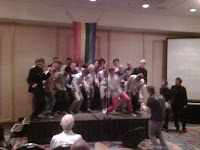
But the highlight of the contest took place in the hallways of the Anaheim hotels where a thousand singers mingled and grouped into ad hoc quartets, singing into the wee hours of each morning. (Above are my chorus-mates Will, Jeff, Greg, and Kevin who still came to BHS in his wheelchair after literally breaking his back 3 weeks ago.) There were various parties, but the best is always the Rainbow Party hosted by the association's gay contingency. Here some of the best groups -- like Zero8 from Sweden in the photo below (music sample) -- perform raunchy versions of their barbershop numbers. It's a particularly funny spectacle since barbershop singers love to cloak themselves in Jesus Christ and America. In fact the Jesus worship and borderline jingoism at BHS can border on creepy, so it was somehow gratifying to hear XXX songs (with lots of on-stage writhing and humping) from a clean-cut baritone who had -- just 6 hours earlier on stage at Honda Center -- righteously credited Our Savior the Lord for his quartet's gold medal.


BHS is an international association and so the contest begins with national anthems from all the countries represented. But unlike other Honda Center events in which a performer sings the Star Spangled Banner, instead a musical director led 8,000 barbershop singers in song. Instinctively, this massive crowd of semi-professional singers performed our anthem in perfect pitch and four part harmony as I've never heard it before. (I tried to bootleg a recording using my Blackberry's measly microphone, which you can download and listen to if you don't mind the repeating "voice logo" of the free converter I used.)

If you're a singer and this event sounds like fun to you, come join Voices in Harmony for our next tuesday night rehearsal -- we audition new members all year round, and we're your best shot outside of Missouri for making it to the international stage!

Blogged with the Flock browser

Tuesday, 2 June 2009

Israel Venture Keynote: When Failure Is An Option

This year the Israel Venture Association invited me to deliver the keynote talk at their annual conference. I agreed, since our 15 investments in Israel have outperformed our overall portfolio, and I wish to support Bessemer's office in Herzliya. After the talk a lot of people asked me for the slides, so I'm publishing them here. 


But SlideShare doesn't include notes, so here's the gist of what I said:

The world lost $100 trillion in the last 6 months. That effects LPs, who have generally told their VCs to slow down, and now have to re-think how to allocate what's left. The venture industry has underperformed as an asset class for over 10 years, and so only the very top performing funds will raise more capital in this climate. [I have to say that at this point in the talk, the folks didn't seem to be enjoying it much.]

But then I talked about the opportunities for innovation, and showed the 2 slides below. I had stolen the first one from someone else's presentation in 2001, and I updated it for today. These illustrate that innovation is decoupled from economic cycles.


Jumping forward, I believe that Slide 17 demonstrates my theory as to why Israeli VC has underperformed the venture industry this decade. In Israeli culture, failure is not an option. So look at all the money going into the 276 active companies among the 325 Israeli startups funded since 2002 (acc. to VentureSource). Wow, imagine how much more valuable that portolio would be without that big blue bar. The little grey bar of failed companies is inconsequential to the portfolio's result, but the blue bar is killing it. They need more grey.


Slide 18 is a prettied up version of my Internet Law that shows why internet investing is the most capital efficient opportunity in venture capital. 
As an example, I shared screenshots of Votizen, a fully functional site that my friend Dave Binetti designed (and he's not a programmer) that operates a social network of registered voters who can share ideas, circulate petitions, and generally assemble online for political purposes. By utilizing contractors around the world, Dave got this site up and running -- fully operational with some nice polish -- for $1203. (That includes the costs of hosting and legally incorporating.)

The rest of the talk was about investing in a capital efficient manner across sectors. My general advice was to plan for failure -- write small checks to test ideas, and assume that many will fail, so you and the entrepeneurs will approach the question of continued funding scientifically, without defensiveness or shame.  The truth is that today, sometimes the cheapest -- and certainly the most accurate -- form of due diligence is to just build the damned thing and see what it happens.

In case that didn't pick up their spirits, I demonstrated capital efficiency at work in my portfolio by describing how Smule partially validated its business on an initial round of $500k from Bessemer, Maples, and Jeff Smith. Showing off my Leaf Trombone, I played an Israeli favorite by Naomi Shemer  titled "Al Kol Eleh" (from which I borrowed the title for my talk "..on the bitter and the sweet"). Here's DocJazz playing it on both Trombone and Ocarina. I think this was the part that drew the standing ovation. At least it made an impression on The Globes, Israel's business daily, which ran a full centerfold on my talk and translated it to Hebrew.


My conclusion: Israel invests more of its GDP in venture capital than any other country, and her economy depends upon technology innovation more than any other nation's.  While failure is hard for them to admit, Israelis understand the need for resource efficiency. If they can make the desert bloom, they can save a shekel in their startups.